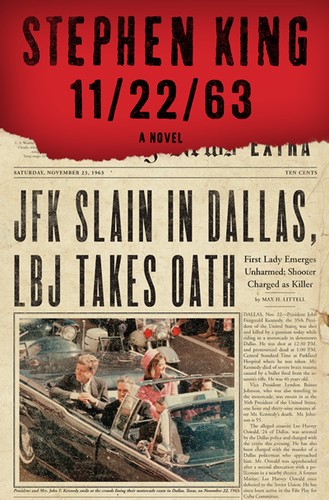
How it was received Reviews were generally positive; The New York Times named it one of 2011's ten best books, and it won the 2011 Los Angeles Times Book Prize and the 2012 International Thriller Writers Award. It became a number-one bestseller and stayed on the NYT list for 16 weeks. — Wikipedia
Ending signals — verified, spoiler-light. Tap a question to see only that answer.
Is the ending happy?
BittersweetDoes it end on a cliffhanger?
NoDo major characters die?
YesHow does 11/22/63 end?
Jake Epping, using the time portal in Al Templeton's diner pantry, spends years living in the past under the alias George Amberson, tracking Lee Harvey Oswald and confirming that Oswald is acting alone with no larger conspiracy. Settled in Jodie, Texas as a schoolteacher, Jake falls in love with the town librarian, Sadie Dunhill, and eventually tells her the truth about who he is and why he has come to this era. He also rescues her from her dangerous, obsessive ex-husband, John, before the two of them travel to Dallas together. On November 22, 1963, Jake manages to intervene at the Texas School Book Depository and stops Oswald from assassinating President Kennedy, but in the chaos of the confrontation Sadie is shot and killed.
Having saved Kennedy, Jake returns to his own present in 2011, only to discover that changing history has produced a nightmarish alternate future. Kennedy survives and serves two terms, but the world spirals into disaster: segregationist George Wallace is elected president in 1968, the Vietnam War does not end but instead escalates into a full-blown World War III, and the United States itself has fractured and decayed. Confronted with the catastrophic ripple effects of his meddling, Jake realizes that saving Kennedy was not the unambiguous good he and Al had believed, and that the timeline he altered must be undone.
Jake goes back through the portal one final time and resets the changes he made, effectively restoring the original timeline in which Kennedy is assassinated as before. Returning again to his own present, he learns that in this restored history Sadie was never killed at all; without his interference in Dallas, she lived a long, full life. He finds a newspaper item revealing that she is now elderly and is being honored in Jodie, Texas as a beloved local figure, celebrated at a town event.
The novel closes with Jake traveling to attend that celebration. He approaches Sadie, now an old woman who does not know him from this version of her life, and asks her to dance. The book ends on this quiet, bittersweet note, with the two of them sharing one last dance together, the tragedy of what could not be kept intact set against the acceptance that the past is, in the end, obdurate and resistant to being rewritten.
✓ Fact-verified against independent sources
Does the series end like the book? — 11.22.63 (2016)
Yes — the series keeps the book’s ending.
11.22.63 · 2016 · series · Hulu · eight episodes
Both end in the same place. Jake stops Oswald, Sadie is killed doing it, and the future he comes back to is wrecked — Kennedy served two terms, the segregationist George Wallace won in 1968, and the war came anyway. So Jake goes back and undoes his own rescue. In the world he restores, Sadie is alive and in her eighties and being honoured in Jodie, and he goes to her: the novel leaves him walking into the party, the series ends on the dance.
The series changes the road rather than the destination. Its portal opens on a day in October 1960 instead of September 1958, and it sends Jake to Holden, Kentucky rather than King's Derry, Maine. It also gives him a partner, the bartender Bill Turcotte, whose own story ends with him going out of a window.
A footnote: King wrote a different last page and dropped it. In that version Jake finds a 2013 news item — Sadie at eighty, married to a man named Trevor Anderson, five children and eleven grandchildren. His son, the writer Joe Hill, talked him out of it.
✓ Every claim checked against the book's plot summary and the series' episode summaries — Wikipedia
Reception summary adapted from Wikipedia, CC BY-SA 4.0.