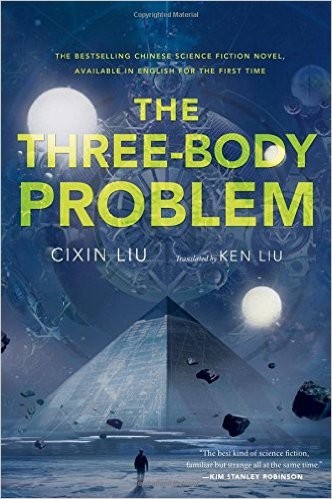
How it was received Won China's Galaxy Award and became the first Asian-authored novel to win the Hugo Award for Best Novel, also earning a Nebula nomination; critics at Kirkus and The New Yorker likened Liu Cixin to Arthur C. Clarke, and the book drew public praise from George R. R. Martin and Barack Obama. — Wikipedia
Ending signals — verified, spoiler-light. Tap a question to see only that answer.
Is the ending happy?
BittersweetDoes it end on a cliffhanger?
NoIs the romance resolved?
No central romanceDo major characters die?
NoHow does The Three-Body Problem end?
The book's climax is the unraveling of the Earth-Trisolaris Organization. Wang Miao, having proven himself in the virtual-reality game Three Body, is inducted into the ETO's inner circle, where Ye Wenjie personally explains the full history: her original broadcast, the reply from Trisolaris warning her to stay silent, and her decision decades later to invite the aliens to Earth anyway because she had lost faith in humanity's ability to fix itself. Wang also witnesses the ETO's internal fracture between the Adventists, who want humanity annihilated to make way for the Trisolarans, and the Redemptionists, who hope to save Trisolaris itself by helping solve its three-body climate problem, and who see coexistence rather than conquest as the goal.
Wang passes what he has learned to Shi Qiang and the military task force. Acting on his tip, security forces raid an ETO gathering and arrest Ye Wenjie. Simultaneously, an international operation moves against the Judgment Day, the converted oil tanker that houses the ETO's transmission equipment and years of recorded communications with Trisolaris, including the detailed message logs about the alien civilization's history and the incoming fleet. Rather than risk destroying this irreplaceable data with an assault or an explosion, the operation uses a web of ultra-thin, ultra-strong nanofiber wire strung across the ship's route through a canal; as the tanker passes through, the wire slices the hull and everyone aboard apart cleanly, killing the ETO members on the ship while leaving the hard drives and archives intact for recovery.
With the ship's records seized and Ye Wenjie in custody, Earth's governments finally have hard confirmation of everything: that Trisolaris is real, that it is a doomed civilization desperate to escape its own unstable star system, that it intercepted Ye's decades-old signal, and that an invasion fleet is already en route on a centuries-long journey toward Earth. The sophons that have been sabotaging fundamental physics research worldwide, and which drove several prominent scientists to suicide earlier in the book, are understood at last as the leading edge of that threat rather than a mysterious breakdown of science itself.
The novel closes with humanity confronting the enormity of what it now knows: an advanced, hostile civilization is coming, arrival is centuries away but inevitable, and Earth's own scientific progress has already been compromised. Wang Miao, Shi Qiang, and their colleagues resolve to organize whatever defense they can, aware that the fight ahead is far larger and stranger than the conspiracy they just uncovered. The book ends not with a battle won but with humanity, for the first time, seeing the true shape of the war it will have to fight.
✓ Fact-verified against independent sources
What happened in The Three-Body Problem? (spoiler-safe refresher)
As book two opens, humanity has just learned, in the closing events of book one, that it is not alone and that it is targeted. Decades earlier, astrophysicist Ye Wenjie, embittered after witnessing her father's death during the Cultural Revolution and recruited into the secret Red Coast radio project, used the Sun to amplify a signal into space. She received a reply from Trisolaris, an alien civilization in the chaotic triple-star Alpha Centauri system, warned not to respond again, and — disillusioned with humanity — answered anyway, effectively inviting an invasion. Trisolaris, whose extreme, unpredictable climate swings between livable Stable Eras and civilization-destroying Chaotic Eras, launched a fleet toward Earth on a roughly 450-year voyage, and deployed 'sophons' — proton-sized supercomputers — to interfere with Earth's fundamental physics experiments and stall human science in the meantime.
Years later, Ye Wenjie met oil heir and radical environmentalist Mike Evans, who financed and built the Earth-Trisolaris Organization (ETO), a secret movement of humans working to help the Trisolaran invasion succeed, with Ye as its leader. The ETO split internally between Adventists, who wanted humanity destroyed outright, and Redemptionists, who wanted to help Trisolaris survive without necessarily annihilating Earth.
In the present day, a wave of scientist suicides linked to sophon-induced disruptions in physics prompted an international task force, including nanotechnologist Wang Miao and detective Shi Qiang, to investigate. Wang's success in the ETO's recruitment tool, a virtual-reality game called Three Body simulating Trisolaris's history, led to his induction into the ETO and a full reveal of the conspiracy by Ye Wenjie herself. Wang tipped off the authorities; Shi Qiang and the military arrested Ye Wenjie at an ETO meeting, and a separate operation seized the ETO's communications ship, the Judgment Day, using nanofiber wire to slice it apart and recover its intact data archive.
Book one ends with Earth's governments now in full possession of the truth: Trisolaris exists, its invasion fleet is already centuries into its journey toward Earth, and sophons have already begun undermining human physics research. Ye Wenjie is in custody, the ETO's central infrastructure has been broken, and Wang Miao, Shi Qiang, and their colleagues are committing themselves to organizing humanity's defense. Going into the next book, the open threads are stark: humanity has thin, damaged science to work with, centuries of lead time before the invaders arrive, an enemy already capable of watching and sabotaging Earth in real time, and no clear strategy yet for how a technologically outmatched civilization could hope to survive the coming confrontation.
✓ Safe to read before Remembrance of Earth's Past #2 — checked for later-book spoilers
Does the series end like the book? — 3 Body Problem (2024)
It gets there, then keeps going — the series runs past the book’s ending.
3 Body Problem · 2024 · series · Netflix · season one
Season one covers Liu's novel and then keeps going into the next one.
The book ends at the moment humanity finds out. Wang Miao tips off Shi Qiang, the army raids the Earth-Trisolaris Organisation's meeting and arrests Ye Wenjie, an international force seizes the converted tanker carrying the ETO's link to Trisolaris, and Earth's governments learn for the first time that an invasion fleet is on its way. That is the last page.
Netflix passes it around the halfway mark. The raid happens — and then the tanker is sliced apart by Auggie's nanofibres, a sophon wraps the planet and writes YOU ARE BUGS across every screen on Earth, Will is euthanised so his frozen brain can be fired at the fleet, the sail fails, and the season closes with the Wallfacer Project announced at the UN and Saul named one of the three, each carrying a plan he can never write down.
The other structural change: the novel's single protagonist becomes five. Wang Miao is replaced by a group of Oxford physicists, and Shi Qiang becomes a British detective.
✓ Every claim checked against the book's plot summary and the series' episode summaries — Wikipedia
Remembrance of Earth's Past — book 1 of 3
- The Three-Body Problem
- The Dark Forest
- Death's End
Catch up on the whole series — spoiler-safe recaps of every book so far →
Reception summary adapted from Wikipedia, CC BY-SA 4.0.