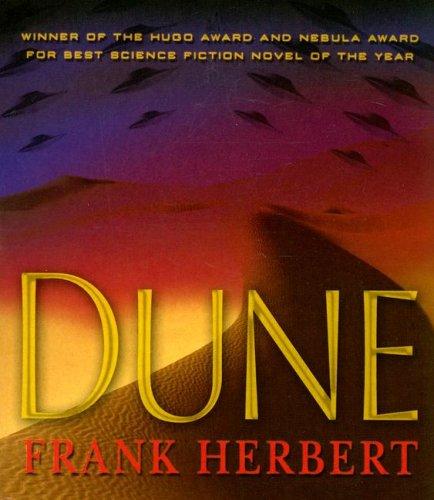
How it was received Dune won the inaugural Nebula Award for Best Novel and tied for the 1966 Hugo, and has sold nearly 20 million copies, remaining one of the best-selling science fiction novels ever. Critics from the Chicago Tribune to Arthur C. Clarke praised its depth, though some, like Algis Budrys, felt it faltered toward its close. — Wikipedia
Ending signals — verified, spoiler-light. Tap a question to see only that answer.
Is the ending happy?
BittersweetDoes it end on a cliffhanger?
NoDo major characters die?
YesHow does Dune end?
After the fall of House Atreides, Paul and his pregnant mother Jessica escape into the deep desert of Arrakis, where they are taken in by the Fremen. Paul rises through Fremen ranks, taking the name Paul-Muad'Dib, marrying into their culture, and training his body and mind through spice exposure and the Bene Gesserit disciplines Jessica taught him. He becomes convinced he is triggering the Kwisatz Haderach abilities the Bene Gesserit had bred for across generations, gaining prescient visions of possible futures, including a horrifying vision of a galaxy-spanning jihad carried out in his name. Jessica becomes a Fremen Reverend Mother by drinking the Water of Life, and in doing so transforms the unborn child in her womb, so that Paul's sister Alia is born already possessing adult awareness and memory.
Over roughly two years, Paul consolidates power among the Fremen tribes, using his visions and the religious mythology the Bene Gesserit's Missionaria Protectiva had seeded on Arrakis to be recognized as their prophesied messiah. He drinks the Water of Life himself, surviving where other men die, and this pushes him fully into his Kwisatz Haderach powers, letting him see across time with terrible clarity. He also weds himself emotionally to Chani, a Fremen woman, who bears him a son named after his father, Leto.
The climax comes when Paul leads the Fremen in an uprising against the Harkonnens and the Padishah Emperor Shaddam IV, who has come to Arrakis with his Sardaukar troops to crush the rebellion in alliance with the Harkonnens. Using the Fremen's mastery of the desert, sandworms as weapons and transport, and the leverage of controlling the planet's spice production, Paul's forces overwhelm the combined imperial and Harkonnen armies at the Battle of Arrakeen. Paul kills the brutal Baron Vladimir Harkonnen's nephew and chief tormentor, Feyd-Rautha, in a formal knife duel, avenging his family. He then confronts Emperor Shaddam IV, forcing his abdication by threatening to destroy the spice entirely using the Fremen's forbidden knowledge of the Water of Life's effect on the sandworms' ecology, which would devastate the Imperium's economy and power structure.
In the closing scenes, Paul takes the throne, forcing Shaddam to give him his elder daughter Princess Irulan in marriage for political legitimacy, while making clear to Jessica and Chani that Irulan will be a wife in name only, a political necessity, and that Chani remains his true love and companion. The novel ends with Jessica quoting to Chani that concubines through history have often held more real power and love than official wives, as the two women watch Paul assume the imperial mantle, with Paul privately aware that he has now set in motion the very jihad he foresaw and feared, unable to fully stop the religious fervor and holy war his rise has unleashed across the galaxy.
✓ Fact-verified against independent sources
What happened in Dune? (spoiler-safe refresher)
Paul Atreides begins the story as the teenage heir of House Atreides, moved with his family to the desert planet Arrakis, the only source of the spice melange. His father is Duke Leto Atreides, his mother is Lady Jessica, a Bene Gesserit concubine who defied her order's breeding program by giving Leto a son instead of a daughter. The family is betrayed by the treacherous Dr. Wellington Yueh, allowing House Harkonnen, under the sadistic Baron Vladimir Harkonnen, and the Emperor's Sardaukar troops to ambush and destroy House Atreides. Duke Leto is killed after a failed attempt to assassinate the Baron with a poison gas tooth. Paul and Jessica flee into the deep desert and are taken in by the native Fremen, a fierce, desert-adapted people led by Stilgar.
Among the Fremen, Paul trains as a warrior and adopts the name Paul-Muad'Dib. He falls in love with and takes as his companion Chani, daughter of the Fremen naturalist/planetologist Liet-Kynes (who dies earlier in the story). Jessica becomes a Reverend Mother by drinking the poisonous Water of Life, which also transforms her unborn daughter in utero; this daughter, Alia, is born with full adult consciousness and unsettling powers. Paul himself undergoes the Water of Life ordeal, awakening as the Kwisatz Haderach, a male Bene Gesserit breeding-program goal with the ability to see across time and possible futures. He gains visions of a terrible jihad that will sweep the galaxy in his name, a fate he fears but ultimately cannot prevent.
Using Fremen fighting skill, control of the sandworms, and leverage over the spice supply, Paul leads a Fremen uprising against the occupying Harkonnen and Imperial forces. In the climactic Battle of Arrakeen, the Fremen crush the combined Harkonnen-Sardaukar army. Paul kills Feyd-Rautha, the Baron's nephew and heir, in single combat, avenging his father and House Atreides. He then confronts Emperor Padishah Shaddam IV directly, using the threat of destroying the spice (and thus the Imperium's economy) to force Shaddam's abdication.
The book ends with Paul seizing the imperial throne. To secure his political legitimacy, he agrees to marry Shaddam's daughter, Princess Irulan, but insists to Jessica and Chani that this will be a marriage of state only, with Chani remaining his true love and companion. Paul has a son, Leto, with Chani. As the book closes, Paul is emperor, but privately aware that the religious fanaticism of the Fremen, now unleashed as his militant followers, is likely to spark exactly the galaxy-wide holy war he foresaw and dreaded. Key open threads heading into the sequel: Paul's uneasy hold on power as a reluctant messiah figure, the unresolved tension between his love for Chani and his political marriage to Irulan, his sister Alia's unnatural powers and status, the Bene Gesserit and Guild's wariness of a Kwisatz Haderach they can no longer control, and the looming specter of the jihad being carried out across the Imperium in Paul's name.
✓ Safe to read before Dune #2 — checked for later-book spoilers
Does the film end like the book? — Dune: Part Two (2024)
No — the film changes the ending.
Dune: Part Two · 2024 · film · dir. Denis Villeneuve
Villeneuve's second film reaches the end of the novel and then pushes past what Herbert put on the page. The book closes on a realisation: the Emperor cedes the throne and promises Irulan's hand, and Paul, having won, understands that he cannot stop the Fremen jihad, because their belief in him is past restraining. It is something he sees coming, not something he commands.
On screen it becomes an order. The Landsraad refuse to accept Paul's ascendancy, so he sends the Fremen up at the fleet in orbit, and the holy war begins while the audience watches. Two more changes land hard. Paul executes Vladimir Harkonnen himself, a killing the novel gives to Alia. And Chani, whose dismay the film stays with when Paul demands to marry Irulan, refuses to bow to him and rides away alone on a sandworm. The novel's last image is a man who has won everything and can stop nothing; the film's is the person who walks out on him.
✓ Every claim checked against the plot summaries of both the book and the film — Wikipedia
Reception summary adapted from Wikipedia, CC BY-SA 4.0.