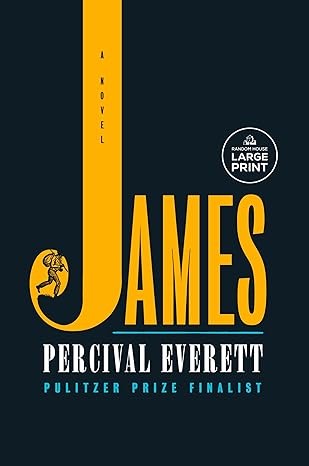
How it was received Critics broadly praised the novel, with The New York Times calling it Everett's most thrilling and soulful work, though some reviews, like the Los Angeles Review of Books, were more lukewarm; it appeared on 33 year-end best-of lists. It won the 2024 Kirkus Prize, the National Book Award for Fiction, and the 2025 Pulitzer Prize for Fiction. — Wikipedia
Ending signals — verified, spoiler-light. Tap a question to see only that answer.
Is the ending happy?
BittersweetDoes it end on a cliffhanger?
NoIs the romance resolved?
No central romanceHow does James end?
After being separated from Huck for a long stretch, Jim ends up sold into Daniel Decatur Emmett's blackface minstrel troupe, the Virginia Minstrels. Though startled by the performers' relatively respectful treatment of him, Jim recognizes he is still bonded labor and would face death if unmasked as Black in front of an audience. He escapes, taking Emmett's notebook, in which he begins writing his own story over the troupe's derogatory songs. His escape inspires Norman, another Black man who had been passing as white within the troupe, to flee as well. Since Norman also wants to buy his wife's freedom, Jim and Norman run a con in which Norman poses as Jim's owner so they can swindle slave buyers out of money. Norman sells Jim to a sawmill, but Jim escapes again, bringing along a young slave girl, Sammy, to save her from being raped by the miller. Sammy is shot and killed by the men pursuing them.
Jim and Norman stow away on a steamboat, which explodes. In the chaos, Jim finds Huck among those thrown overboard and chooses to save him rather than Norman. When Huck asks why Jim would risk himself for him, Jim finally drops the performed dialect and persona he has maintained throughout the book and tells Huck the truth: he is Huck's biological father. Huck is hurt that Jim never trusted him with this, but he still insists on staying with Jim and returning to Hannibal, even as Jim urges him to go his own way. Back in Hannibal, Jim learns that his wife Sadie and daughter Lizzie have already been sold off, and no one will tell him where.
The Civil War has begun by this point, but Jim understands intellectually and viscerally that a war fought by others will not itself deliver his freedom or his family's. In fevered, dreamlike interludes, he argues with an imagined John Locke about the nature of the conflict as a war whose outcome will decide who is free, and speaks with Voltaire's Cunégonde, who warns him that even without the legal status of slave, he will remain treated as human property. Freed from his former caution about self-preservation, Jim kills a slave overseer who is a rapist, an act of direct vengeance rather than survival. He then confronts Judge Thatcher at gunpoint and forces him to reveal where Sadie and Lizzie have been taken.
Jim tracks them to a plantation used for breeding enslaved people, where he organizes and leads an armed raid, sparking a mass breakout of the enslaved people held there. Reunited with Sadie and Lizzie, he leads the escaped group north, out of Missouri and into Iowa. In the novel's final movement, having shed the protective mask and dialect he wore for white people throughout the book, he claims his full name for the first time: James.
✓ Fact-verified against independent sources
Reception summary adapted from Wikipedia, CC BY-SA 4.0.